Why understanding addiction vs misuse matters
When you live with substance use, it can be hard to tell when things have crossed a line. You might wonder if what you or your loved one is experiencing is “just misuse” or if it has become addiction. Having addiction vs misuse explained clearly gives you language, validation, and a roadmap for next steps.
Clinicians use specific definitions. Addiction is a chronic, relapsing brain disorder marked by compulsive substance use despite harm and long-lasting changes in brain circuits that affect reward, stress, and self-control [1]. Drug misuse, on the other hand, often begins as voluntary use for perceived benefits, but if it continues over time, control can slip and addiction can develop [1].
You do not have to wait for everything to collapse before you take your concerns seriously. Understanding early behavioral, emotional, and functional warning signs can help you recognize when casual use turns into addiction and seek support sooner.
What experts mean by misuse, abuse, and addiction
Terms like misuse, abuse, dependence, and addiction are often used interchangeably in everyday conversation. Clinically, they mean different things. Knowing the difference helps you describe what is going on more accurately and decide what level of help might be needed.
What drug misuse is
Drug misuse typically means using a medication in a way that does not match medical or legal guidelines, but not always with the intent to get high. Examples include taking extra doses because you feel the prescribed amount “is not doing the job,” using a prescription that was not written for you, or stopping a medication without medical guidance [2].
You might see misuse when you:
- Take someone else’s pain pills after a minor injury because you still “have some soreness”
- Double up on anxiety medication before a stressful event without talking to your doctor
- Save leftover prescriptions to “use later if I need them”
Misuse can be occasional and may not immediately disrupt your life. However, repeated misuse increases the risk that your brain will adapt to the substance and move you further along the spectrum toward addiction.
What drug abuse is
Drug abuse is typically more intentional. It involves using substances primarily to feel high, to change how you feel, or to harm yourself, rather than to treat a legitimate medical condition. This category often includes using prescription drugs without a prescription or using alcohol and illicit drugs to chase a buzz [2].
With abuse, you may notice:
- Drinking to black out or regularly drinking more than you planned
- Taking opioid pills or benzodiazepines specifically to escape or feel euphoric
- Using drugs or alcohol to cope with every emotional low, conflict, or stressor
Abuse can be short term, but it often sets the stage for physical dependence and addiction, especially with substances like OxyContin or Xanax, which can quickly lead to tolerance, higher doses, and serious health risks including overdose and death [3].
What addiction and Substance Use Disorder mean
Addiction is the most severe form on the spectrum. It is defined as a chronic, relapsing disorder with compulsive drug seeking and use despite harmful consequences and long-term changes in brain circuits involved in reward, stress, and self-control [1].
Clinically, addiction is usually diagnosed as severe Substance Use Disorder (SUD). SUD is a mental health condition that ranges from mild misuse to severe addiction and is diagnosed when at least two specific signs appear over a 12-month period [4].
With addiction, substances release large amounts of dopamine, which reinforces use and leads to cravings and ongoing unhealthy use [4]. Brain imaging studies show physical changes in areas involved in judgment, decision-making, memory, and behavior control, which helps explain why stopping can feel so difficult even in the face of serious harm [1].
Key differences: addiction vs misuse explained
You might be less interested in labels and more concerned with what is actually happening in daily life. Still, having addiction vs misuse explained in plain language can guide your decisions.
At a high level, the biggest differences involve intent, control, consequences, and brain changes.
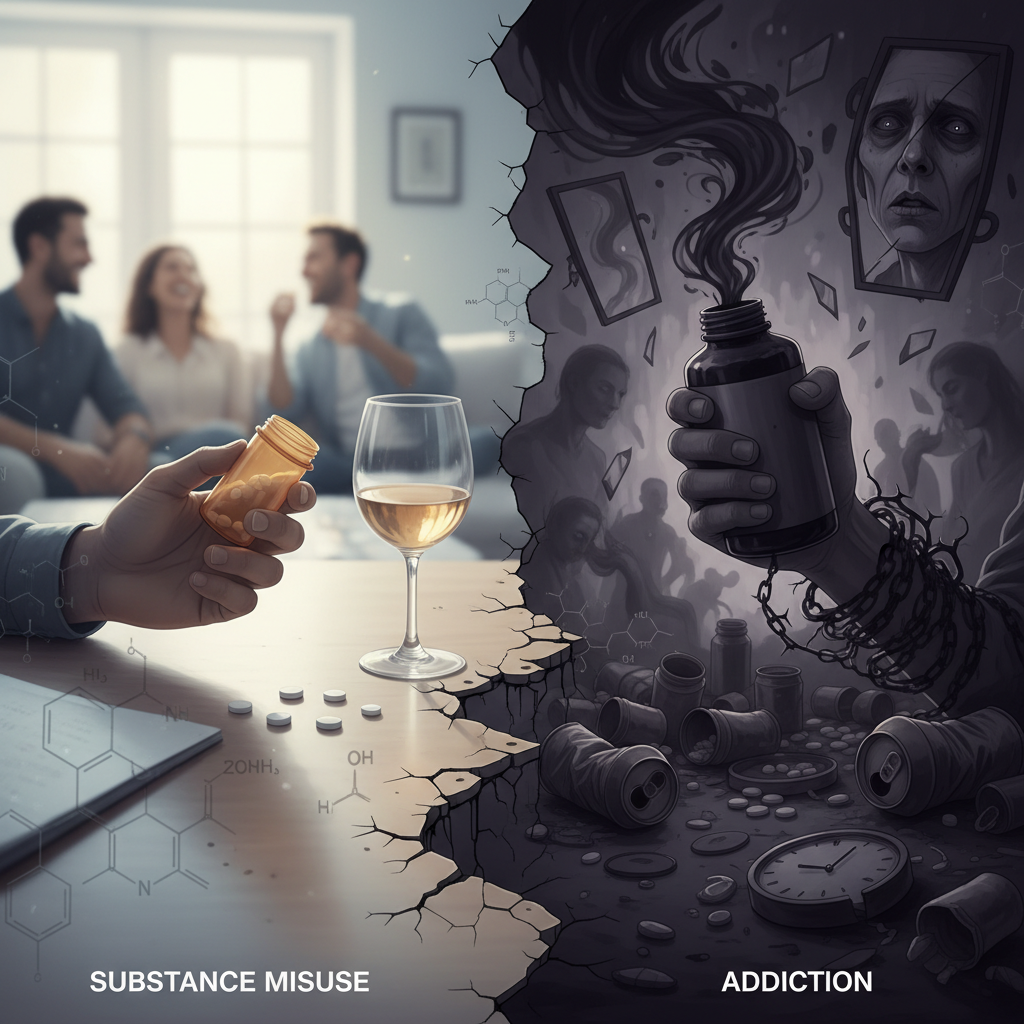
In misuse, you are bending the rules of use. In addiction, the substance is bending the rules of your life.
Comparing misuse and addiction in everyday terms
| Aspect | Misuse | Addiction |
|---|---|---|
| Intent | Usually to treat a symptom or “feel better” physically or emotionally, not necessarily to get high | Often to relieve withdrawal, cravings, or emotional pain, and sometimes just to feel “normal” |
| Control | You can usually choose to stop or cut back, especially when there is a clear reason | Control is significantly impaired, even when you want to stop and see the damage happening |
| Frequency | May be occasional or situational | Regular, often daily or multiple times per day |
| Consequences | May be mild or limited, such as a short-term side effect or one close call | Ongoing negative impact on health, work, school, relationships, finances, and legal status |
| Brain changes | Some adaptation possible, especially with repeated misuse | Clear, long-lasting changes in reward and self-control circuits that drive compulsive use [1] |
You might notice you or your loved one moving from misuse into addiction when there is a shift from “I am choosing to take this” to “I do not feel like I have a choice anymore.” This loss of control is one of the clearest addiction and loss of control signs to pay attention to.
The spectrum: from casual use to serious problems
Substance use does not jump from “no problem” to “full-blown addiction” overnight. Instead, it usually follows a progression. Understanding this spectrum helps you see where you might be and what to do next.
According to the Cleveland Clinic, Substance Use Disorder exists along a continuum from mild misuse to severe addiction, with diagnosis based on specific criteria over a 12-month period [4].
You can think of this progression as:
-
Casual or experimental use
Use is occasional, typically in social or time-limited situations, with little impact on functioning. -
Misuse
Medications or substances are used in ways that bend the rules of safe or prescribed use. There may be early emotional or behavioral changes, but daily life still mostly works. -
Abuse and emerging dependence
Use becomes more frequent. You start to rely on substances to cope. Tolerance, cravings, or withdrawal may appear. You may notice early warning signs of substance use disorder. -
Addiction (severe SUD)
Use feels compulsive. Stopping is extremely hard despite harm. Substance use is now at the center of life, and serious disruption in health, relationships, and responsibilities is often present.
Recognizing where you are on this path can help you see how addiction progresses over time and when it is time to seek structured support.
Behavioral warning signs that use is becoming addiction
Behavior often shifts before health fully breaks down. Watching for changes in behavior can give you one of the earliest windows into whether you are facing misuse, escalating abuse, or addiction.
You might find it helpful to compare what you see with common behavior changes linked to addiction.
Changes in patterns, priorities, and honesty
You may be moving away from simple misuse and toward addiction if you notice:
-
Increasing secrecy around use
Hiding bottles or pills, being vague about where you are going, or minimizing how much you are using. -
Shifting priorities
Activities, hobbies, and relationships that used to matter start to fade. More time, energy, and planning go toward obtaining and using substances. -
Breaking personal rules
You might have promised yourself, “I will only drink on weekends,” or “I do not use when I am watching the kids,” and you find yourself crossing those lines. -
Risky decisions
Driving after drinking, using alone, mixing substances, or continuing to use despite past close calls.
These changes are often early high functioning addiction warning signs. On the surface, work and family life may look intact, but underneath, substance use is starting to direct decisions.
Social and relational shifts
Addiction rarely affects only one person. You may see:
- Pulling away from family or long-term friends, especially those who question your use
- Spending more time with people who use heavily or who support your behavior
- More frequent arguments about drinking or drug use
- Broken promises to cut back or quit
If the people closest to you express concern and you feel defensive, dismissed, or ashamed, it can be a sign that your relationship with substances is bigger than simple misuse. These interpersonal strains often appear before obvious functional collapse.
Emotional and mental health red flags
Emotional changes are just as important as what you can see from the outside. Substances alter brain chemistry, and over time this can change how you feel, think, and respond to stress.
Cleveland Clinic explains that substances trigger dopamine release, reinforcing use and driving cravings and continued unhealthy use [4]. These brain changes can show up in mood and thinking in ways that are easy to overlook or mislabel.
Mood swings, anxiety, and depression
You may notice:
- Irritability, anger, or agitation when you cannot use or when someone questions your use
- Increasing anxiety or restlessness between episodes of use
- Periods of low mood, numbness, or hopelessness, especially when planning to stop
- Emotional blunting, where you feel “flat” without the substance
These are common emotional signs of substance abuse. While mood issues can have many causes, a pattern that tracks closely with substance use is a strong sign that you are moving along the SUD spectrum.
Thinking changes and denial
Addiction-related brain changes affect judgment and decision-making [1]. This can look like:
- Making excuses for using, such as “everyone would drink if they had my stress”
- Minimizing problems, for example, “I have never gotten a DUI, so it is not that bad”
- Blaming others for consequences related to use
- Difficulty imagining social events, relaxation, or coping without substances
These mental patterns can make it much harder to recognize when to take addiction seriously. If you see yourself defending your use more and more, it is worth pausing and considering whether that defense is another symptom.
How addiction affects daily life and responsibilities
One of the clearest ways to distinguish occasional misuse from addiction is to look at functioning. You might intellectually understand addiction vs misuse, but it becomes very real when you see how addiction affects daily life.
Addiction tends to disrupt your ability to meet everyday responsibilities consistently and safely.
Work, school, and home functioning
You may be crossing from misuse into addiction if substances are starting to interfere with:
-
Work or school
Showing up late, missing days, declining performance, or losing jobs or important opportunities related to use. -
Home responsibilities
Neglecting childcare, household duties, or financial obligations, or leaning heavily on others to pick up the slack. -
Self-care
Ignoring health appointments, hygiene, nutrition, or sleep due to use or recovery from use.
These are common functional signs of addiction. They can be subtle at first, such as occasional lateness or small mistakes, then gradually grow into more serious problems.
Relationships and safety
Addiction also shows up in how you handle commitments and safety:
- Repeated broken promises to loved ones about reducing or stopping use
- Legal issues such as DUIs, public intoxication, or possession charges
- Accidents or injuries while intoxicated
- Continued use despite clear harm, such as a partner threatening to leave or child custody concerns
When you see escalating consequences and little lasting change in behavior, it likely means you are facing more than simple misuse. These are often strong signs someone needs addiction treatment.
Subtle early signs: catching problems before crisis
Not every warning sign is dramatic. In fact, some of the most important red flags are the subtle ones you can easily dismiss. Catching these early can help you recognize dependency early and seek support before you reach a breaking point.
Early behavioral shifts
Subtle signs that substance use might be moving beyond occasional misuse include:
- Planning your day or week around opportunities to drink or use
- Feeling disappointed or irritable when plans change and you cannot use
- Increasingly choosing social situations where substance use is central
- Gradually increasing your dose or number of drinks to get the same effect
With prescription drugs, early subtle signs of drug addiction can include running out of medication early, visiting multiple doctors, or feeling anxious when you are close to the end of a prescription.
Changes specific to alcohol or opioids
Some substances have clear, early indicators:
- With alcohol, you may notice rationalizing daily drinking, hiding how much you drink, or wondering when drinking becomes a problem.
- With opioids, you might see escalating doses, using pills for stress or sleep rather than pain, or experiencing early withdrawal between doses. These can be early opioid addiction symptoms.
If you are asking yourself whether these early patterns “count,” they already matter. You do not need a crisis to justify getting clarity or support.
Risk factors that make addiction more likely
Not everyone who misuses substances will develop addiction, but some people are at higher risk. Understanding risk factors can help you put your situation in context and make more informed choices.
NIDA notes that both biological factors, such as genes, developmental stage, and ethnicity, and environmental factors, such as family, school, and neighborhood, influence risk, with genetics and epigenetics accounting for an estimated 40 to 60 percent of addiction risk [1].
You may be more vulnerable to moving from misuse into addiction if you have:
- A family history of addiction
- A personal history of trauma, chronic stress, or mental health conditions
- Easy access to addictive substances through work, home, or social circles
- Started using heavily as a teen or young adult, when the brain is still maturing
Adolescents are at particularly high risk because the prefrontal cortex, which governs decision-making and impulse control, is still developing. Drug exposure during this time can trigger long-lasting changes in the brain [1].
Risk does not equal destiny, but it does mean that what might be “casual misuse” for someone else could move much more quickly into addiction for you or your family member.
When to take action and seek support
You might hope to find a clear test that tells you exactly when misuse has become addiction. In reality, it is more helpful to ask: is substance use starting to harm you or the people you care about, and is it hard to stop even when you want to?
The Cleveland Clinic notes that treatment intensity typically matches severity. Misuse might respond to education, medical guidance, and brief counseling, while addiction often requires medically supervised withdrawal, behavioral therapies, and sometimes medications to manage cravings and withdrawal symptoms [4].
You might consider more structured help if you recognize:
- Multiple early signs of addiction in adults such as growing tolerance, cravings, and failed attempts to cut back
- Clear mental and behavioral addiction symptoms, including obsession with substances and loss of control
- Noticeable changes in how addiction impacts responsibilities like work, parenting, or finances
If you are unsure what you are seeing, it can help to walk through a resource like how to know if substance use is a problem. The details you notice can guide conversations with a healthcare provider or addiction specialist.
You do not need to wait until things are “bad enough” by anyone else’s definition. The right time to take addiction seriously is whenever you notice that substances are beginning to take more from your life than they give.
Moving forward with clarity and compassion
Understanding addiction vs misuse explained in clinical terms is only part of the picture. The other part is how it feels to live with these patterns day to day. You might see moments of control alongside episodes that deeply worry you. That mixed picture can be confusing and painful.
Remember:
- Misuse is about using in unsafe or non-prescribed ways.
- Addiction is about losing control and continuing to use despite harm.
Wherever you or your loved one falls on this spectrum, you are allowed to seek information, support, and treatment. If you recognize early red flags, such as shifting priorities, emotional volatility, or creeping functional decline, taking steps now can prevent deeper harm later.
Exploring resources on when to take addiction seriously and how to recognize dependency early can help you decide on your next step. Reaching out for help is not a verdict on your character. It is simply an acknowledgment that your health and your family matter more than any substance.